Reference · Cycling law
Cycling laws UK guide: the Highway Code rules for cyclists and what the law requires
Updated
The junction where the ring road meets the high street has a painted lane that vanishes exactly where you need it most, and the Highway Code rules for cyclists do not make that lane compulsory. You learn very quickly that holding your position in the main traffic flow is safer than hugging a kerb that suddenly disappears. Understanding the cycling laws UK riders live with means seeing the vast difference between what is written in the statutory rules and what is merely painted on the tarmac. Paint is not legislation. The rules matter. This guide covers what you are legally required to do on the road and how the statutes govern your commute.
Cycling laws UK: what is law and what is advice
The Highway Code rules for cyclists do not all carry the same legal weight, and most cycling laws UK riders meet come from two places: the Road Traffic Act 1988 and the Highway Code. When a rule uses the words MUST or MUST NOT in red capital letters, it is a strict legal requirement. Ignoring it constitutes a criminal offence. When the text uses SHOULD or SHOULD NOT, it is advisory. Failing to follow advice is not a crime in itself, but ignoring an advisory rule can be used as evidence in court to establish liability under Section 38 of the Road Traffic Act 1988. You hear arguments at public meetings about cyclists breaking the law by not wearing high-visibility clothing. The law makes no such demand.
The Highway Code rules for cyclists, rule by rule
The primary block of cyclist rules sits within the Highway Code, running from Rule 59 to Rule 82. These paragraphs cover clothing, night riding, junctions and road positioning. Beyond these specific bicycle laws, the general rules for all vehicles apply to you as well. The legal framework treats a bicycle as a vehicle. This means that rules regarding zebra crossings, give way lines and yellow box junctions bind a person on a bike just as they bind a person driving a lorry. You must obey all traffic signs and traffic light signals (Highway Code Rule 69).
Where you may ride: roads, dual carriageways, pavements and cycle tracks
You may ride on all public roads unless an explicit sign prohibits it. You may cycle on a dual carriageway: no rule in the cyclist section bans it. Highway Code Rule 72 says traffic on most dual carriageways moves quickly and to take extra care crossing slip roads. Cycling on motorways is prohibited (Highway Code Rule 253). Cycling on the pavement is prohibited under Section 72 of the Highways Act 1835. This is reinforced by Highway Code Rule 64. When you review a drawing pack for a new consultation scheme, look closely at the legend for cycle tracks. On a segregated track you MUST keep to the side intended for cyclists (Highway Code Rule 62). On a shared route without a separator, take care when passing pedestrians and give them plenty of room (Highway Code Rule 62).
Lights, reflectors, brakes and bells
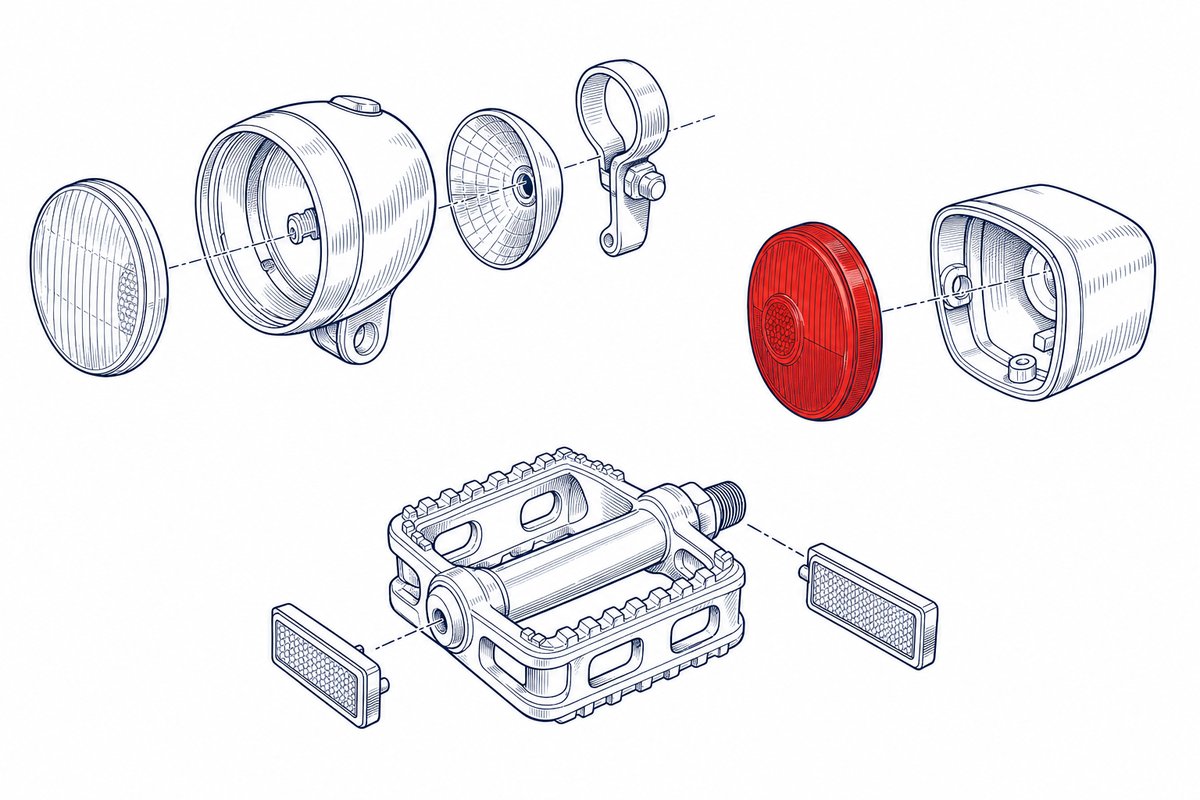
The Road Vehicles Lighting Regulations 1989 make it a strict legal requirement to have working lights on your bike between sunset and sunrise. You need a white front light, a red rear light and a red rear reflector, plus amber pedal reflectors on any cycle made after 1 October 1985 (Highway Code Rule 60). Flashing lights are perfectly legal if they flash between one and four times a second. The Pedal Cycles (Construction and Use) Regulations 1983 require two independent braking systems.
Junctions, red lights, advanced stop lines and arm signals
Junctions are where conflicts happen. You must stop at red lights (Highway Code Rule 71 and Road Traffic Act 1988, Section 36). Advanced stop lines are the painted boxes at traffic lights. Under Highway Code Rule 71, when the traffic lights are red, you may cross the first stop line, but you MUST NOT cross the final stop line. Highway Code Rule 73 is about junctions and special cycle facilities.
Riding two abreast, passengers and child seats
The idea that riding two abreast is illegal is a persistent myth. Highway Code Rule 66 specifically states you can ride two abreast. It suggests it can be safer to do so, particularly in larger groups. You only need to move into single file to allow cars to pass when it is safe for them to do so. Highway Code Rule 68 says you MUST NOT ride in a dangerous, careless or inconsiderate manner or hold onto a moving vehicle. Section 24 of the Road Traffic Act 1988 makes it illegal to carry a passenger on a bicycle unless the bicycle has been built or adapted for that exact purpose. Carrying a friend on the handlebars or the rear pannier rack is an offence (Highway Code Rule 68).
Offences: careless and dangerous cycling, drink and drugs
Careless cycling is defined in Section 29 of the Road Traffic Act 1988 as riding without due care and attention or without reasonable consideration for other road users. Section 28 of the same Act defines dangerous cycling as riding in a way that falls far below what would be expected of a competent and careful cyclist. Under Section 30 of the Road Traffic Act 1988, it is an offence to ride a cycle on a road or other public place while unfit through drink or drugs. The test is whether you are so much under the influence that you lack proper control of the bicycle.
Section 141 of the Crime and Policing Act 2026, which received Royal Assent on 29 April 2026, adds four offences to the Road Traffic Act 1988: causing death by dangerous cycling, causing serious injury by dangerous cycling, causing death by careless or inconsiderate cycling, and causing serious injury by careless or inconsiderate cycling. The maximum sentence for causing death by dangerous cycling is life imprisonment; causing serious injury by dangerous cycling and causing death by careless or inconsiderate cycling carry up to five years, and causing serious injury by careless or inconsiderate cycling up to two years. The section has been passed but is not yet in force. It applies in England, Wales and Scotland from a date set by commencement regulations, and until then the offences above are the ones a court applies.
Helmets, hi-viz and other things the law does not require
You will often hear loud demands for mandatory helmets and registration plates. Neither is part of UK cycling laws. Highway Code Rule 59 says you should wear a cycle helmet, but it uses the word 'should', making it purely advisory. There is no cycle helmet law making it compulsory to wear one on the road. The same applies to high-visibility clothing. Another common myth is road tax. Vehicle excise duty is based on emissions and does not apply to bicycles. Stick to the actual statutes.
E-bikes and e-scooters: where the rules differ
An electric bike must meet the Electrically Assisted Pedal Cycle regulations to be treated as a normal bicycle. The motor must have a maximum power output of 250 watts and it must stop assisting you when you reach a speed of 15.5 miles per hour. You must also be at least fourteen years old to ride one on a public road. If the motor can propel the bike without you pedalling, or if it exceeds those limits, it becomes a motorcycle in the eyes of the law. Unless you are riding a rental scooter as part of an official government trial, riding an e-scooter on a public road, pavement or cycle lane is illegal under the Road Traffic Act 1988.
After a collision: reporting, claims and insurance
Third-party insurance is not legally required for cyclists in the UK but is worth having; the cycle insurance questions page sets out where cover comes from. After a collision, exchange details and note witnesses as good practice.
Before your next ride: a short guide
On the count sheet, it is always the hesitation at a junction that causes the near misses. Before your next ride, run through this short checklist:
If you want a junction changed, the campaign guides are the next step, and the local campaign groups already know the council officers involved.
Four checks before you set off
1. Use working lights and reflectors at night (Highway Code Rule 60).
2. Stop at red lights and do not cross the final stop line (Highway Code Rule 71).
3. Stay off the pavement unless it is a shared-use track (Highway Code Rule 64).
4. Take extra care crossing slip roads and on fast dual carriageways (Highway Code Rule 72).
Questions readers ask
Q 13.1What are the rules for riding a bike in the UK?
The rules are a mix of statutory law and advice; the Highway Code rules for cyclists are rules 59 to 82, and the cycling laws UK courts apply sit in the Road Traffic Act 1988 and its regulations. You must obey all traffic signs and signals (Rule 69), have lights at night (Rule 60), and avoid cycling on the pavement (Rule 64). Following the advisory rules is recommended, but ignoring the mandatory rules is a criminal offence.
Q 13.2Are you legally allowed to cycle on the pavement?
No, it is an offence to cycle on the pavement. This prohibition is established under Section 72 of the Highways Act 1835 and restated in Highway Code Rule 64. You may only ride on a path if it is explicitly marked as a shared-use cycle track.
Q 13.3What are the new laws on cycling in the UK?
Two changes stand out. The Highway Code update of January 2022 introduced a hierarchy of road users and clarified road positioning: cyclists may ride in the centre of their lane on quiet roads, in slower traffic and on the approach to junctions (Highway Code Rule 72). Section 141 of the Crime and Policing Act 2026 creates new offences of causing death or serious injury by dangerous, careless or inconsiderate cycling, with a maximum of life imprisonment for causing death by dangerous cycling. The Act passed in April 2026, but these offences are not yet in force; they start on a date set by commencement regulations.
Q 13.4Is it a legal requirement to wear a cycle helmet?
There is no legal requirement to wear a cycle helmet in the UK. Highway Code Rule 59 states that you should wear a helmet, which makes it advice, not a legal requirement. You cannot be fined or prosecuted simply for riding without a helmet.
Q 13.5Do cyclists have to stop at red lights?
Yes, cyclists must stop at red lights. Highway Code Rule 71 and Section 36 of the Road Traffic Act 1988 make it a legal requirement for all vehicles to obey traffic light signals. Crossing the stop line when the light is red is an offence.
Q 13.6Can cyclists ride on a dual carriageway?
Yes, you are permitted to cycle on a dual carriageway. No rule in the cyclist section bans cycling on dual carriageways. Highway Code Rule 72 says traffic on most dual carriageways moves quickly and to take extra care crossing slip roads. Cycling on motorways is prohibited (Highway Code Rule 253).
Q 13.7Can cyclists ride two abreast?
Yes, cyclists are legally allowed to ride two abreast. Highway Code Rule 66 notes that riding two abreast can actually be safer in large groups. You should be considerate of other road users and move into single file to let cars pass when it is safe to do so.
Q 13.8Is it a legal requirement to have a bell on a bike?
There is no legal requirement to have a bell on your bicycle when riding it on the road. The Pedal Bicycles (Safety) Regulations 2010 require a bell to be fitted when a bike is sold new, but you do not have to keep it. Highway Code Rule 66 simply advises you to use a bell or your voice to warn others.
Q 13.9Do I need lights on my bike at night?
Yes, you absolutely need lights on your bike at night. Under the Road Vehicles Lighting Regulations 1989 and Highway Code Rule 60, you must display a white front light, a red rear light and a red rear reflector between sunset and sunrise, and a cycle made after 1 October 1985 also needs amber pedal reflectors. Flashing lights are permitted.
Q 13.10What age can children cycle on the pavement?
The law does not specify a minimum age limit exception for cycling on the pavement. Under Section 72 of the Highways Act 1835, pavement cycling is illegal for everyone. However, children under the age of ten cannot be held criminally responsible in England and Wales, and in Scotland the age of criminal responsibility is twelve.
Q 13.11Is it illegal to cycle after drinking?
Yes, it is an offence to cycle while unfit through drink or drugs. Section 30 of the Road Traffic Act 1988 makes it illegal to ride a bicycle on a road if you lack proper control of the vehicle. There is no specific breath limit, but the police can arrest you.
Q 13.12What is rule 75 of the Highway Code?
Rule 75 of the Highway Code is about two-stage right turns at some signal-controlled junctions. It explains that you should go ahead on green to the cycle symbol and turn arrow, wait, and then complete the turn when the far-side lights turn green.